



Introduction
In the field of medical device manufacturing, compliance is an absolute must. The UDI system implemented by the NMPA and international regulatory bodies requires medical products to be traceable throughout their entire lifecycle, from source to end-user. As the core of medical electronic devices, the physical identification of printed circuit board assemblies (PCBAs) and their association with data form the cornerstone for meeting these regulatory requirements. In PCBA manufacturing, standardizing the execution of UDI barcode marking and ensuring data compliance in production control are critical quality and technical challenges that precision manufacturing enterprises must overcome.
Physical Carriers and Marking Specifications for UDI on PCBA
Due to extremely limited space and exposure to harsh environments such as high humidity and chemical cleaning, the selection of UDI carriers and marking precision for medical-grade PCBA directly affect the integrity of the traceability chain. The industry typically employs laser marking technology to directly etch high-density QR codes onto the solder mask layer or copper-free areas of the PCB. The barcode format must strictly adhere to three mainstream international standards. For miniature, high-density boards, the physical dimensions of the QR code typically need to be reduced to within 2.0 millimeters by 2.0 millimeters. This requires laser marking machines to possess micron-level focusing precision and thermal output control to prevent burning the substrate and exposing the fiberglass. The reflected QR codes must meet or exceed Class B standards for reflectance and contrast as specified in ISO/IEC 15415 to ensure rapid reading by inline barcode scanners and during subsequent finished product assembly. Additionally, marking locations should avoid high-temperature zones in reflow oven and wave soldering processes to prevent solder splatter or flux residue from covering the barcode, or causing the markings to peel off or wear away during subsequent cleaning.
Synthesis and Management of UDI Components at the Data Level
The UDI consists of a Product Identifier (DI) and a Production Identifier (PI), both of which are collected and dynamically synthesized at different stages of PCBA manufacturing. The Product Identifier is fixed and corresponds to a specific PCB model and its hardware version information. The Production Identifier, on the other hand, is dynamic and includes the production lot number, serial number, production date, and software/firmware version number. Before SMT production begins, the MES system retrieves the UDI-DI base data for the project's batch from the ERP system. When the PCB passes through the laser marking machine, the system generates a unique UDI-PI dynamic serial number, which is captured and verified by a high-resolution camera. Finally, the DI and PI data are linked in the database backend within milliseconds. This linking mechanism not only establishes a digital identity for each individual board but also provides a unique primary key for data addressing during downstream testing and programming processes.
Error-Proofing Controls and Material Traceability Compliance During the SMT Process
Once the association between physical barcodes and data is established, production control for PCBA manufacturing must build a rigorous error-proofing network centered around this UDI barcode. In the SMT assembly process, the SMT component change error-proofing system is critical. When operators replace moisture-sensitive components-such as resistors, capacitors, or main control chips-they must use a PDA barcode scanner to sequentially scan the barcode on the component tray, the placement station code, and the UDI QR code on the board itself. Only when the system verifies that the component's batch and model absolutely match the BOM in the current UDI data chain will the placement machine unlock and allow operation. During the reflow soldering stage, real-time temperature curves measured by temperature probes and thermal compensation data are also automatically archived in the board's UDI history via barcode scanning. This process control ensures that, should any component exhibit batch-related quality drift, the factory can use the UDI data chain to trace back and isolate the affected PCB batch, precisely limiting the scope of rework and product recall to single-digit quantities.
Deep Integration of Test Data with UDI and Quality Audits
The ultimate compliance of medical devices is not only reflected in physical assembly but also depends on the absolute authenticity of functional test data. During the FCT (Functional Compliance Test) and high-voltage withstand testing phases, test equipment mandates the scanning of the PCBA's UDI QR code before startup. Upon completion of the test run, all quantified electrical metrics-such as output voltage fluctuations, static power consumption current, and communication waveform delays-are fully linked to that specific UDI. If test results fail to meet standards, the system physically locks the board via the barcode mechanism, preventing it from proceeding to subsequent coating and packaging processes. When preparing for ISO 13485 medical device quality management system audits or on-site inspections by high-end medical clients, technicians need only enter any UDI serial number into the system to instantly retrieve a full-chain digital audit report covering incoming materials, surface-mount assembly, soldering, and testing, thereby presenting irrefutable evidence of compliance to the audit experts.
Verification of Marking Durability in Long-Term Service Environments
Over their service life-which can span several years or even decades-medical electronic devices must endure rigorous clinical sterilization, salt spray corrosion, and thermal cycling. To ensure UDI remains legible throughout the product lifecycle, manufacturers must incorporate accelerated aging and durability verification during the pilot production phase. Sample boards marked with UDI must be placed in a temperature and humidity test chamber for continuous operation testing under a "double 85" environment (85°C temperature and 85% relative humidity). After testing, a 100-grid adhesion test is performed on the barcode area using specialized peel tape to ensure the marking layer shows no blistering, cracking, or peeling. Additionally, the samples must undergo repeated wiping tests using common clinical chemical solvents, such as anhydrous ethanol and isopropyl alcohol, with a minimum of 50 wipes. Only if the barcode's readability rating remains at Grade C or higher after exposure to chemical and physical stress can the marking and process solution be deemed compliant.
Quality management for medical devices does not tolerate any breaks in the data chain; every minute detail of the marking bears the responsibility for patient safety. If your medical-grade electronic products are facing issues such as blurred UDI markings, incomplete traceability data chains, or failure to meet stringent medical device audit compliance requirements, this indicates that your on-site control processes require a systematic overhaul to ensure compliance.
We operate a digital medical PCBA production facility compliant with ISO 13485 standards, equipped with a high-precision integrated laser marking and inspection system, and have established a comprehensive MES digital traceability system covering the entire process from the component level to the finished product UDI.
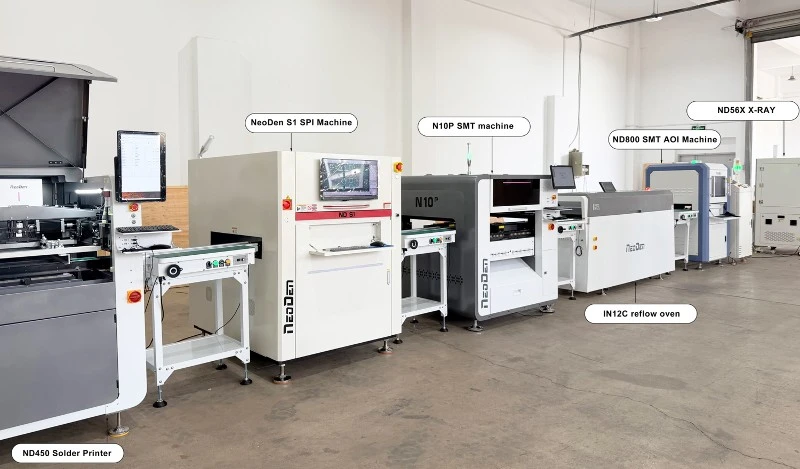
Company profile
- Established in 2010 with 200+ employees & 27,000+ Sq.m. factory of independent property rights, to ensure the standard management and achieve the most economic effects as well as saving the cost.
- Owned the own machining center, skilled assembler, tester and QC engineers, to ensure the strong abilities for NeoDen machines manufacturing, quality and delivery.
- 40+ global partners covered in Asia, Europe, America, Oceania and Africa, to successfully serve 10000+ users in all of the world, to ensure the better and faster local service and prompt response.
- 3 different R&D teams with total 25+ professional R&D engineers, to ensure the better and more advanced developments and new innovation.
- Skilled and professional english support&service engineers, to ensure the prompt response within 8 hours, solution provides within 24 hours.
- The unique one among all of the Chinese manufacturers who registered and approved CE by TUV NORD.
- NeoDen supplies life-long technical support and service for all of the NeoDen machines, moreover, regular software updates based on the using experiences and actual daily request from the endusers.