



Introduction
NeoDen IN6 is a desktop reflow soldering machine designed for prototyping and small-batch SMT production. It features full hot-air reflow, a compact design, and a built-in fume filtration system. This article provides a comprehensive quick start guide based strictly on the IN6 user manual.
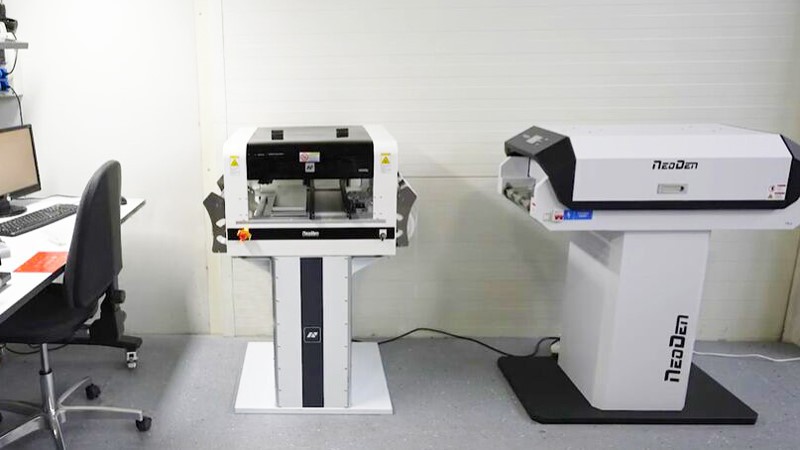
Preparation and Installation Environment
A stable power supply and a sturdy work surface are essential for ensuring the equipment operates normally and that process parameters remain consistent.
1. Power Requirements Check
- Power Grid Specifications: The IN6 requires 110V/220V AC single-phase power. This means it can be plugged into standard household outlets or office power strips.
- Power Consumption Control: Since reflow soldering machines are continuous heating devices, it is recommended to install a dedicated single-circuit circuit breaker for them. Never share an extension cord or power strip with inductive load devices such as high-power SMT placement machines or energy-intensive air compressors, to prevent transient voltage surges caused by frequent startups of other equipment from interfering with the temperature control system's sensors.
2. Work Surface Material Selection
The manufacturer does not recommend placing the IN6 on a wooden work surface, primarily for reasons of heat resistance and long-term safety. Prolonged operation at high temperatures may cause the wood to age and warp. Therefore, it is recommended to use a metal or industrial workbench to ensure equipment stability and safety.

Power-On and Control Panel Configuration
The NeoDen IN6 utilizes a color touchscreen for microprocessor-based intelligent control.
1. Temperature Profile Management
- Graphical Display: The control panel supports "Graphic Display Mode," which dynamically displays the current actual temperature curve in real time using time and temperature as dual axes.
- Profile Storage: The device's mainboard can store and freely recall up to 16 programmable temperature profiles.
- Seamless One-Button Switching: Process engineers can set up independent working files for conventional leaded solder paste (e.g., Sn63/Pb37), lead-free high-temperature solder paste (e.g., SAC305), and low-temperature bismuth solder paste (e.g., Sn42/Bi58). The color display allows switching between multiple languages and units (Celsius and Fahrenheit), facilitating setup and line changes for various products.
2. Power-On Preheating Control
- Preheating Time: The IN6 system's heat-up time to achieve thermal equilibrium is approximately 25 minutes.
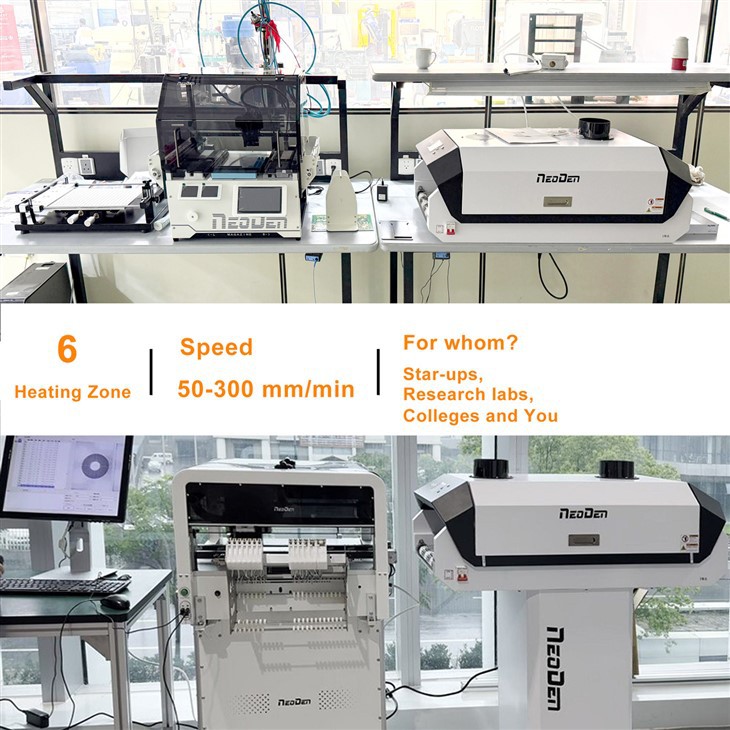
- Temperature Control Mechanism: The 25-minute wait ensures the furnace chamber reaches full thermal equilibrium. The temperature control system uses closed-loop data from high-sensitivity temperature sensors to perform precise current pulse adjustments (PID control) across a total of six temperature zones (three upper and three lower), ensuring uniform heat penetration through the chamber's airflow and aluminum alloy heating plates.
- Temperature Stability: This control algorithm ensures that the temperature smoothly transitions to a constant state after reaching the target value, preventing overshoot. The officially rated control accuracy is ±0.2 °C. Before the first weld, the operator must wait until the real-time curve on the control panel has completely flattened and confirm that a stable constant-temperature state has been reached before starting the conveyor belt to begin welding.

Practical Guide to Setting Temperature Curves for Lead-Free Solder Paste (SAC305)
When setting the SAC305 temperature curve, adjust the setpoints for the six temperature zones according to the following process principles:
- Zones 1–2 (Preheating and Activation Zones): Maintain a stable temperature between 150°C and 180°C. Hot air circulates via forced convection to uniformly heat the PCB and components, causing the flux in the solder paste to begin volatilizing and removing oxidation layers from metal surfaces.
- Zones 3–4 (Constant-Temperature Wetting Zone): Gradually raise the temperature to 180°C–210°C. This stage ensures that components with high thermal mass (such as BGAs and shielding covers) reach the same thermal saturation as smaller external resistive and capacitive components, thereby eliminating temperature variations across the board.
- Zones 5–6 (Reflow Soldering Zone): Since the theoretical melting point of SAC305 is 217°C, to achieve perfect eutectic soldering and form high-quality intermetallic compounds (IMC layers), the actual peak temperatures (Peak Temp) for Zones 5 and 6 are typically set between 240°C and 250°C (Zone 6 can be set to a maximum of 300°C, meeting the requirements of the vast majority of lead-free processes).
- Exit Cooling: After the PCB exits the heating chamber, high-efficiency cooling fans at the exit rapidly solidify the solder joints with forced cold air, preventing grain coarsening and ensuring full, bright solder joints.
Adjusting the Conveyor Chain Speed
According to the guidelines in Section 9.1, "Soldering Analysis" of the IN6 user manual, the chain speed must be set with precise balance:
Risks of excessive chain speed: If the speed is set too high in a blind pursuit of throughput, the PCB will not remain in each temperature zone long enough, resulting in insufficient heat exchange. This can lead to incomplete reflow or cold solder joints.
- Risks of excessive chain speed: If the chain speed is set too low (e.g., below 5–10 cm/min), the PCB will remain in the high-temperature zone for an excessively long time. This not only causes the flux to overheat and char (flux coking) but also, by exceeding the PCB's glass transition temperature (Tg), results in discoloration, brittleness, and even severe warping or deformation of the entire board.
- Initial process recommendations: For standard 1.6 mm double-sided multilayer prototype boards, it is recommended to set the initial chain speed between 15–20 cm/min, followed by fine-tuning using a oven temperature tester (temperature probe).
Daily Equipment Maintenance: Two Essential Maintenance Practices for Sustained High Yield
1. Fume filtration system maintenance: Replace the filter cartridge every 8 months
Page 16 of the manual, under "9.3 Machine Maintenance," explicitly states in the first item: "Change the filter regularly" to maintain effective fume extraction and a safe working environment.
- Maintenance Cycle: The manufacturer's standard reference is 8 months. This can be adjusted based on actual PCB throughput and usage frequency.
- Replacement Procedure: After the equipment is shut down and has cooled to below 40°C, use a Phillips screwdriver to evenly remove the 12 mounting screws on the back of the machine housing. Then, pull out the built-in smoke filter cartridge assembly in a parallel motion to replace it.
2. Drive Bearing Lubrication: Regularly apply high-temperature lubricating oil
The user manual provides clear operating instructions in the machine maintenance section: "Regularly add high-temperature lubricating oil to the drive chain bearings."
- Cause Analysis: The spring mesh belt and drive chain operate continuously in a temperature range of 200°C to 250°C, and are inevitably subjected to corrosion from the condensation of volatile flux residues. If lubricating oil is not replenished regularly, the bearings are highly susceptible to dry wear or the formation of viscous coking.
- Chain Reaction of Failures: Once bearing friction becomes uneven, the drive chain will generate high-frequency mechanical vibrations during operation. Such vibrations are critical in the reflow zone where solder paste is fully melted, as they can easily cause widespread misalignment or displacement of micro-surface-mount components in a suspended state.
- Manufacturer's Specifications: It is recommended that operators use a dedicated oil gun to apply industrial lubricating oil or grease suitable for high-temperature environments to the drive bearings and chain joints every 100 consecutive operating hours. This ensures the conveyor belt operates smoothly and at a constant speed within the speed range of 5–30 cm/min.
Conclusion
Mastering the correct setup of the NeoDen IN6, calibrating the control panel, and achieving a proper balance between temperature control and chain speed are the first steps toward ensuring product soldering quality. Standardized daily inspections and equipment maintenance not only stabilize product soldering yield rates but also represent a long-term investment in extending the service life of SMT production line assets.