



Introduction
For electronics manufacturing companies, choosing the right SMT production line not only affects PCB assembly quality but also impacts production efficiency, equipment investment, and future business expansion. For small-to-medium-sized SMT factories, electronics R&D teams, and small-to-medium-volume PCBA manufacturers, striking a balance between budget, production capacity, and production flexibility is a key challenge that must be addressed when purchasing equipment.
This article will analyze production requirements, equipment selection, production capacity planning, budget, and actual configuration, and introduce two NeoDen SMT solutions to help you develop a clearer procurement strategy.
What Is a Small-to-Medium-Sized SMT Production Line?
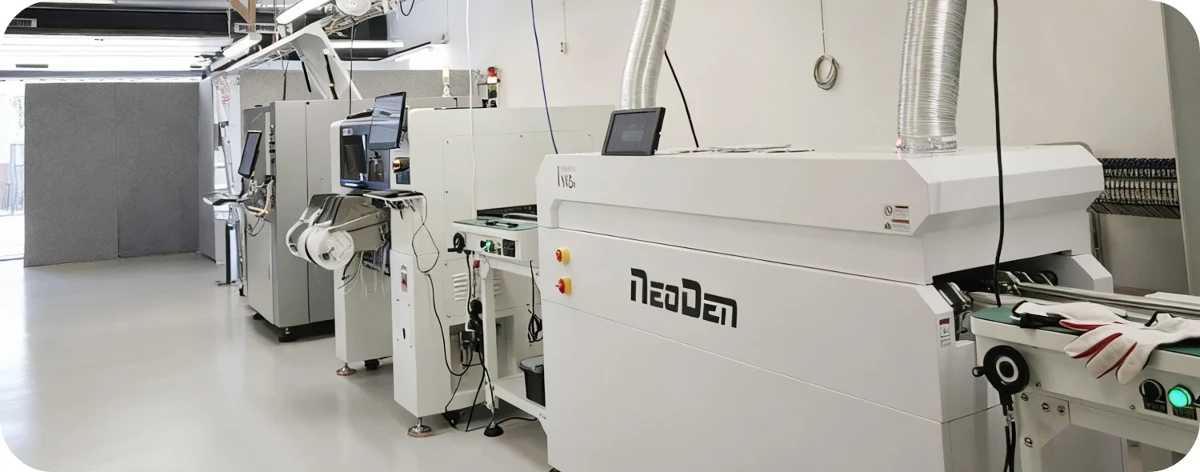
A small-to-medium-sized SMT production line refers to a surface-mount production line configured to meet the needs of small-to-medium-volume electronics manufacturing, product R&D, and high-mix PCB assembly. Compared to large, highly automated SMT production lines, small-to-medium-sized lines place greater emphasis on aligning equipment investment with actual needs, as well as flexibility in production space, product changeovers, and daily operations.
These types of production lines are commonly found in the following scenarios:
- Electronics manufacturing startups that need to establish their own PCB assembly capabilities.
- Small-to-medium-sized EMS factories that need to handle PCBA orders from different customers.
- Electronics R&D departments needing to conduct prototype validation and small-batch trial production.
- Companies with existing production lines that need to add an independent production line or expand current capacity.
It is important to note that there is no universal output standard for small and medium-sized production lines that applies to all companies. Equipment configuration should be determined comprehensively based on PCB size, component count, order structure, production cycle time, and automation requirements-rather than solely on the basis of factory size.
What factors should be considered when selecting a small-to-medium-sized SMT production line?
1. Define Target Output and Production Cycle Time
Before selecting a model, it is recommended to first clarify:
- How many PCBs need to be produced per day or per shift?
- Approximately how many components are mounted on each PCB?
- Will production be stable and long-term, or will there be frequent product changes?
- Are there plans to increase orders or expand product types in the coming year?
This information will help you determine the capacity range of the SMT placement machine and assess whether additional automated auxiliary equipment is needed.
2. Confirm PCB Dimensions and Component Compatibility Range
Different PCB products have varying requirements for SMT equipment.
In addition to the PCB's length, width, and thickness, you must also consider component packaging, component height, fine-pitch ICs, connectors, and other special components. For products containing fine-pitch chip components or complex ICs, you should also verify whether the placement machine's vision recognition capabilities, nozzle configuration, and placement process are suitable.
It is recommended to prepare representative PCB files and BOMs before purchasing so that equipment suppliers can evaluate compatibility based on actual products. Relying solely on the maximum placement speed listed in equipment brochures makes it difficult to determine whether the equipment is suitable for your actual production tasks.
3. Evaluate Factory Space and Line Layout
Small and medium-sized factories typically need to make full use of limited production space. Therefore, equipment footprint, PCB conveyance direction, operator workstations, material replenishment areas, and maintenance access aisles should all be planned in advance.
If using a semi-automatic solder paste printer, manual board loading and unloading as well as the operating cycle time must also be considered. If there are future plans to add board loaders/unloaders, transfer stations, or AOI inspection equipment, sufficient installation and conveyance space should be reserved.
It is recommended to plan the entire production line first before purchasing individual machines. This reduces the risk of discovering mismatches in conveying directions, equipment interfaces, or on-site space only after the equipment arrives at the factory.
4. Comprehensively Consider the Procurement Budget and Long-Term Operating Costs
The investment in an SMT production line involves more than just the purchase cost of the three core machines; it may also include feeders, nozzles, stencils, spare parts, training, installation and commissioning, maintenance, and energy consumption.
For companies setting up a production line for the first time, it is advisable to initially configure equipment that meets core process requirements and then gradually add auxiliary equipment based on quality management and automation needs.
However, one should not focus solely on the lowest purchase price. If the equipment cannot meet target output levels or if frequent line changes result in significant downtime, long-term production costs may actually be higher.
5. Focus on Technical Support and Future Expansion
Whether equipment can be successfully put into production also depends on installation and commissioning, operator training, troubleshooting, and the supply of spare parts.
When purchasing, confirm what services the supplier can provide and how to obtain technical support if equipment issues arise. At the same time, consider whether the existing equipment will remain suitable when increasing production capacity or introducing new products in the future.
What Equipment Is Required for Small and Medium-Sized SMT Production Lines?
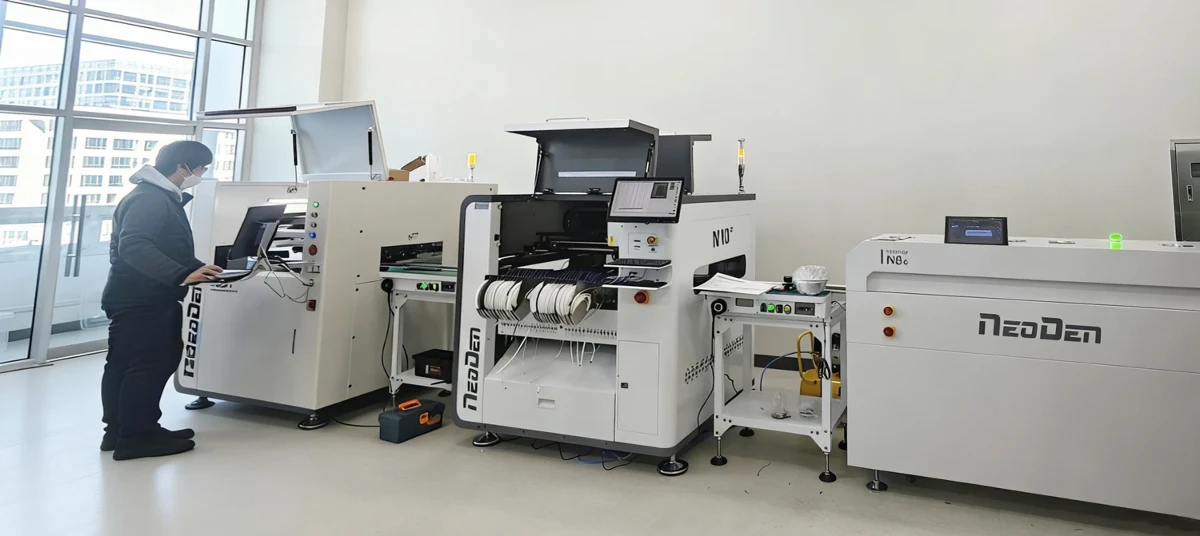
A basic SMT production line typically includes a solder paste printer, an SMT machine, and a reflow oven. These three components are responsible for solder paste printing, electronic component placement, and soldering, respectively, and together constitute the core process flow of PCB surface mount assembly.
1. Solder Paste Printer
A solder paste printer uses a steel stencil to apply solder paste to the PCB pads. The printing position, amount of solder paste, and release quality all affect the quality of subsequent placement and soldering.
For small and medium-sized factories seeking to control initial investment while maintaining a degree of operational flexibility, semi-automatic solder paste printers are worth considering. For example, the NeoDen YS350 is a semi-automatic solder paste printer with a maximum PCB size of 400 × 240 mm. It is suitable for inclusion in small-to-medium-sized SMT production line configurations once PCB dimensions, printing processes, and operating methods have been confirmed to meet requirements. Refer to the YS350 product specifications for detailed information.
2. Pick and Place Machines
Pick and place machines are responsible for placing resistors, capacitors, ICs, and other surface-mount components onto designated positions on the PCB; they are a critical component in selecting an SMT production line.
When selecting a pick and place machine, it is necessary to consider the rated placement speed, component compatibility range, number of feeders, vision recognition system, changeover efficiency, and actual production requirements.
The NeoDen 9 and NeoDen N10P can be used in production line configurations with different requirements. The specific differences between these two models should be evaluated based on official specifications and actual PCBs and BOMs, rather than by comparing CPH values alone.
3. Reflow Oven
A reflow oven uses controlled heating to guide solder paste through the preheating, ramp-up, reflow, and cooling stages, forming reliable solder joints.
When selecting a reflow oven, focus on the heating zone configuration, temperature control, conveyor speed, PCB size, thermal load, and the ability to adjust temperature profiles. Different combinations of PCBs and components may require different reflow profiles; therefore, soldering quality cannot be judged solely by the number of heating zones.
The NeoDen IN8C features an 8-zone design-four zones on top and four on the bottom-and utilizes hot-air convection heating. It can be considered as a reflow oven option for small- to medium-sized SMT production lines, but final confirmation still requires verification of PCB dimensions, process requirements, and on-site installation conditions.
4. Add Auxiliary Equipment as Needed
In addition to the three core machines, you can configure the line with a PCB conveyor, SMT loader, SMT unloader, SMT buffer, and AOI inspection equipment based on production needs.
If production batches are small and operators can handle board loading and unloading, a simpler layout can be adopted initially. If you wish to reduce manual handling, improve continuous operation capabilities, or enhance quality inspection, you may further evaluate automation and inspection equipment.
NeoDen Recommended SMT Production Line Solutions for Small and Medium-Sized Enterprises
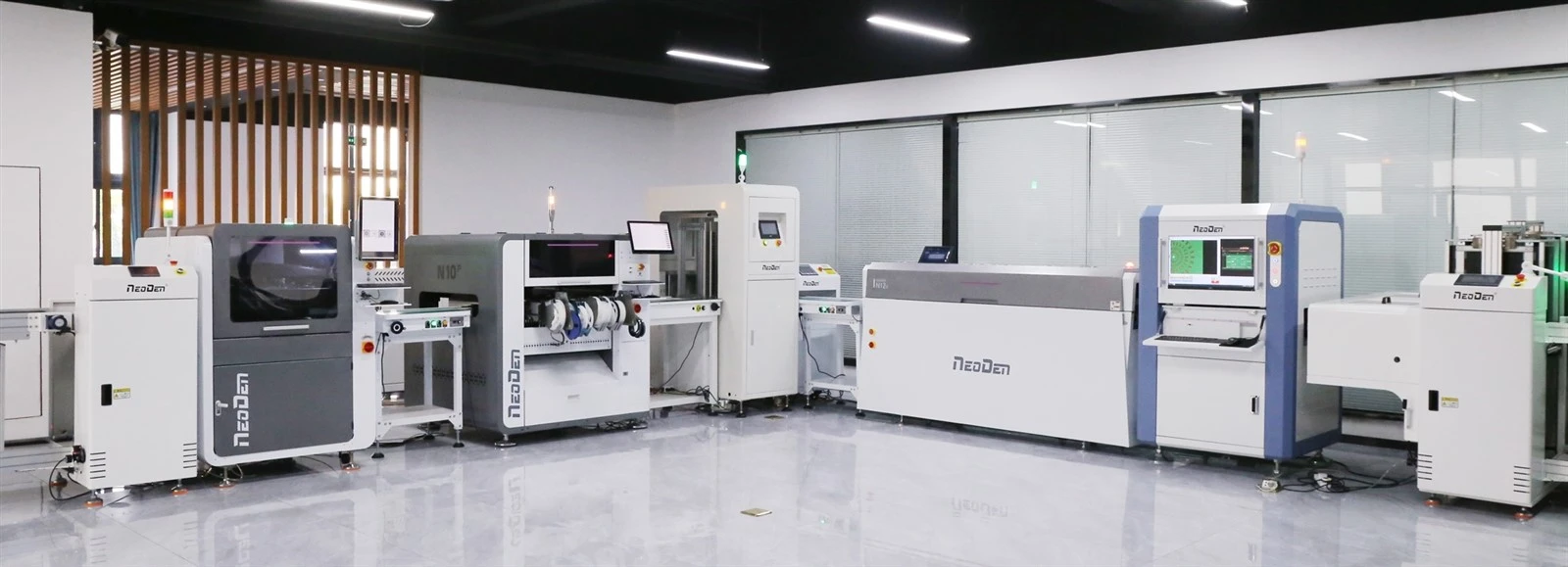
For small and medium-sized electronics manufacturers seeking to establish stable SMT assembly capabilities, NeoDen offers a core equipment combination consisting of the YS350 solder paste printer, an SMT placement machine, and the NeoDen IN8C reflow oven. Depending on production needs, the SMT placement machine can be either the NeoDen9 or the NeoDen N10P.
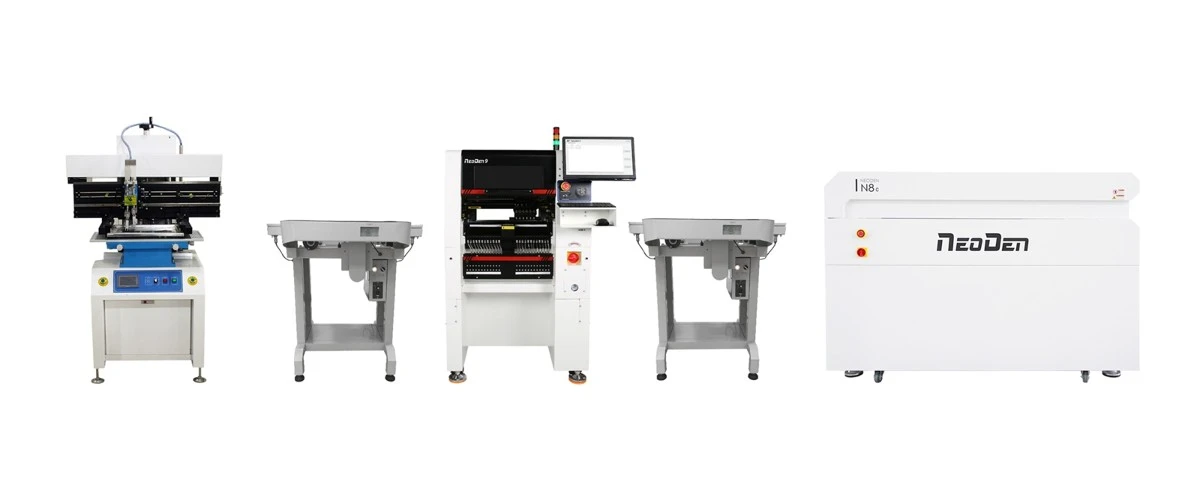
Solution 1: NeoDen YS350 + NeoDen9 + NeoDen IN8C
This solution is suitable for users seeking to balance mass production requirements, product flexibility, and equipment investment. At its core, it covers the three main processes of SMT assembly through a semi-automatic solder paste printer, a six-head placement machine, and an 8-zone reflow oven.
NeoDen YS350 Semi-Automatic Solder Paste Printer
Responsible for printing solder paste onto PCB pads. When purchasing, verify that the maximum PCB size, stencil specifications, and actual printing process are compatible.
NeoDen9 SMT Placement Machine
The NeoDen 9 has a nominal maximum placement speed of 14,000 CPH and features six independently controlled placement heads. Actual throughput depends on the component mix, PCB design, feeder configuration, and operating conditions.
NeoDen IN8C Reflow Oven
Featuring an 8-zone design with four temperature zones each on the top and bottom, this oven performs reflow soldering via hot air convection. Before use, appropriate temperature profiles must be established and validated for the specific PCB and component mix.
Who Is This Solution For?
This configuration serves as a viable option for small- to medium-sized PCBA production, high-mix electronics assembly, and production capacity planning. Whether it is suitable for a specific facility should be further evaluated based on target output, PCB dimensions, component types, and actual process requirements.
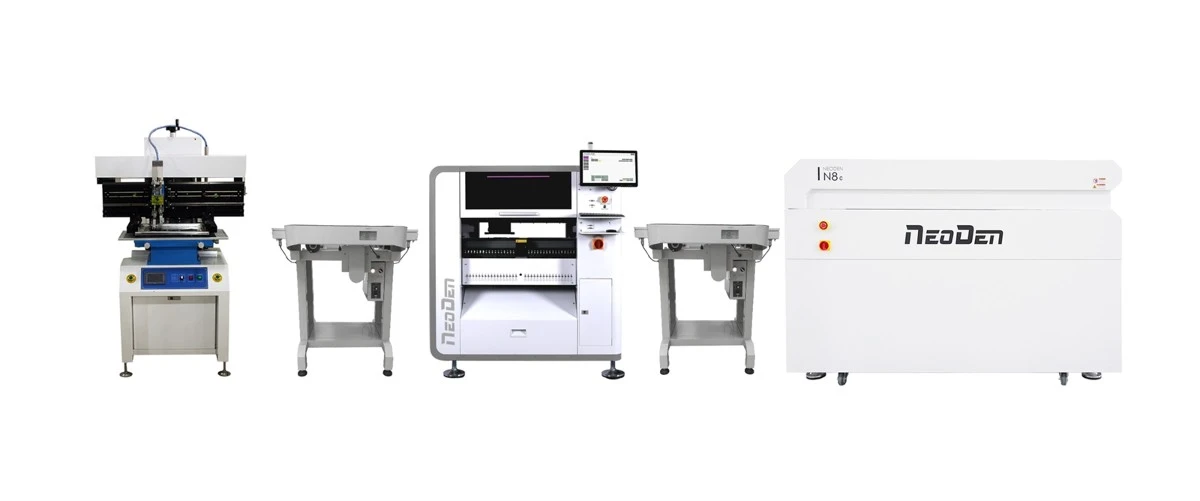
Solution 2: NeoDen YS350 + NeoDen N10P + NeoDen IN8C
If the purchaser wishes to further evaluate placement capacity, feeder configuration, and future production capacity requirements, they may consider replacing the NeoDen 9 with the NeoDen N10P, paired with the same NeoDen YS350 and IN8C.
NeoDen YS350 Solder Paste Printer
Responsible for front-end solder paste printing, providing the solder paste foundation for component placement.
NeoDen N10P SMT Placement Machine
The NeoDen N10P features 8 placement heads, with a nominal maximum placement speed of 20,000 CPH, and supports up to 80 8 mm tape feeders. Specific compatibility and production performance must be evaluated based on actual components and PCBs.
For users with a wide variety of components, those needing to evaluate feeder configurations, or those with higher future production capacity requirements, it is important to compare whether the N10P's configuration aligns with actual production plans.
NeoDen IN8C Reflow Oven
Responsible for back-end reflow soldering. When selecting this equipment, key considerations include PCB dimensions, temperature profiles, conveyor speed, and soldering process requirements.
Who is this solution suitable for?
This combination is suitable for users seeking to evaluate production needs that require higher placement capacity or greater flexibility in feeder configurations. However, the placement machine's maximum CPH does not directly equate to the entire line's output; verification based on actual products and preceding/subsequent processes is still required.
What Is the Budget for a Small-to-Medium-Sized SMT Production Line?
The price of an SMT production line depends on the equipment models, level of automation, optional equipment, and scope of services. Price differences between configurations cannot be explained solely by the speed of the placement machine.
When purchasing, it is recommended to break down the costs into three parts:
- Core equipment investment: Solder paste printer, pick and place machine, and reflow oven.
- Supporting equipment: Feeders, nozzles, stencils, transfer stations, and other auxiliary equipment.
- Long-term operating costs: Installation and commissioning, training, maintenance, spare parts, and energy consumption.
If your budget is limited, prioritize ensuring the core process is complete first, then gradually add board loading/unloading, conveying, and inspection equipment as order volume grows.
If there are specific production capacity requirements, you should simultaneously compare equipment investment with expected production efficiency to avoid subsequent upgrade costs resulting from insufficient configuration.
What information should be prepared before purchasing an SMT production line?
Before requesting quotes from equipment suppliers, it is recommended to compile the following information:
- PCB specifications: Length, width, thickness, board type, and panelization method.
- BOM (Bill of Materials): Component packages, quantities, and information on special components.
- Production targets: Output per shift, daily order volume, and product varieties.
- On-site conditions: Available space, power supply, air supply, and equipment layout requirements.
- Automation needs: Whether automatic board loading/unloading, PCB conveyance, and AOI inspection are required.
- Service requirements: Installation and commissioning, training, spare parts supply, and technical support.
This information helps suppliers assess equipment suitability and provide more targeted configuration recommendations.
Frequently Asked Questions (FAQ)
1. What equipment is required for a basic SMT production line?
A basic SMT production line typically requires a solder paste printer, an SMT placement machine, and a reflow oven to perform solder paste printing, component placement, and soldering, respectively. Whether to add board loaders/unloaders, transfer stations, and AOI should be determined based on production cycle time, automation level, and quality inspection requirements.
2. Are semi-automatic solder paste printers suitable for small-to-medium-sized SMT production?
They may be suitable. For production scenarios with moderate output where operators can handle PCB loading and unloading, semi-automatic printers can be considered. However, if order volumes are high and manual cycle times have become a bottleneck, fully automatic printing equipment should be evaluated.
3. What is the difference between the NeoDen9 and the NeoDen N10P?
The two machines differ in terms of the number of placement heads, nominal maximum placement speed, and feeder configurations. When making a selection, consider the PCB, BOM, component types, actual placement time, and future production capacity requirements-rather than simply comparing nominal speeds.
4. Can small-to-medium-sized SMT production lines manufacture different types of PCBs?
Yes, provided the equipment supports the corresponding PCB sizes, component packages, and process requirements. Switching between different products may also involve program adjustments, feeder replacements, stencil changes, and reflow profile verification; therefore, the changeover process should be evaluated in advance.
5. Can the SMT production line be expanded later?
Phased expansion can be considered, but equipment interfaces, PCB conveyance methods, on-site space, and process compatibility must be confirmed in advance. Developing a reasonable expansion plan before purchasing will help reduce future retrofitting costs.
Conclusion
When selecting a small-to-medium-sized SMT production line, the key is not to choose the combination with the highest speed or the largest number of machines, but to ensure that the three core processes-solder paste printing, component placement, and reflow soldering-meet actual production needs.
The final configuration should be determined based on PCB size, BOM, target output, production space, and budget.
Planning your own SMT production line?
Feel free to contact NeoDen and provide your PCB dimensions, BOM, target output, and factory space information. Our team can assist you in evaluating the appropriate equipment configuration based on your specific application requirements.