


Introduction
For many companies just starting to set up an SMT production line, questions such as "What is reflow soldering?", "How should the reflow soldering temperature be set?", and "Why do soldering results vary when switching to a different PCB on the same machine?" often warrant more attention than the purchase of the equipment itself.
Simply put, reflow soldering is an SMT soldering process that uses controlled temperature and dwell time to subject the solder paste on a PCB to preheating, activation, melting, and cooling, ultimately forming stable solder joints.
Reflow soldering oven is not simply a matter of "heating the PCB until the solder melts." What truly determines soldering quality is the temperature profile the PCB undergoes throughout the oven-commonly referred to as the reflow temperature profile.

What is reflow oven? How does it work?
In the SMT process, solder paste is first printed onto the PCB pads through a steel stencil, and then a pick and place machine positions components such as resistors, capacitors, ICs, QFNs, and BGAs into their corresponding locations. At this stage, the components are only temporarily adhered to the solder paste and have not yet formed final solder joints.
Once the PCB enters the reflow oven, the solder paste undergoes a series of changes as the temperature gradually rises. Solvents and volatiles are released, the flux begins to activate, and the PCB and components gradually reach the optimal temperature for soldering. The solder paste then melts, the molten solder wets the pads and component leads, and finally, the solder joints solidify upon cooling.
Therefore, a typical SMT process can be summarized as follows:
Solder paste printing → Component placement → Reflow soldering → Solder joint formation → Inspection
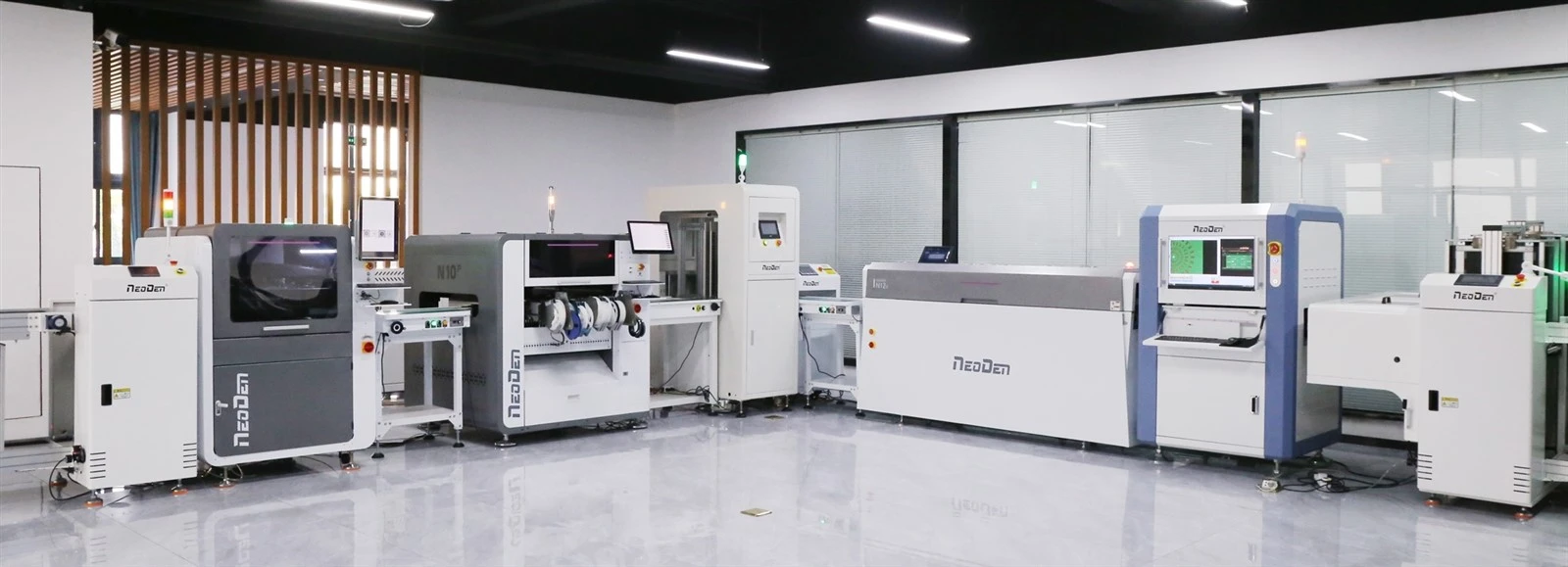
NeoDen IN12C is an automatic reflow soldering machine designed specifically for this process. It features 12 temperature zones-6 on the top and 6 on the bottom-and uses hot-air convection to heat the PCB.
What is the difference between reflow soldering machine and wave soldering machine?
Both reflow soldering machine and wave soldering machine are used for PCB soldering, but they operate differently.
Reflow soldering primarily relies on solder paste and a controlled temperature profile to solder surface-mount components, making it one of the core pieces of equipment in an SMT production line. Wave soldering machine, on the other hand, involves passing the PCB through a wave of molten solder and is more commonly used for through-hole components or specific mixed-assembly processes.
If the production primarily involves surface-mount components, then reflow soldering is typically an indispensable piece of equipment in an SMT production line.

How does reflow soldering work? A detailed explanation of the 4 temperature stages
The core of reflow soldering machine is not a single fixed temperature, but rather a complete temperature curve that the PCB follows over time. The NeoDen IN12C user manual divides this process into several main stages: preheating, activation, reflow, and cooling.
Stage 1: Preheating Zone
When the PCB first enters the reflow oven, the temperature must not rise sharply or suddenly. The primary purpose of the preheating stage is to gradually warm the PCB, components, and solder paste in preparation for subsequent soldering.
If the temperature rises too quickly, the PCB and components may experience significant thermal shock, and the rapid evaporation of solvents in the solder paste may also increase the likelihood of soldering defects.
Therefore, in the reflow soldering preheating zone, attention must be paid not only to the final temperature but also to the rate of temperature rise.
Stage 2: Activation and Holding Zone
Upon entering the activation zone, the PCB's temperature continues to rise or remains within a relatively stable range. One of the key functions of this stage is to gradually equalize the temperature across different areas of the PCB while allowing the flux in the solder paste to fully take effect.
For PCBs with large surface areas, thick copper layers, or high component density, heat distribution across the board is not entirely uniform. If certain areas heat up significantly faster than others, this may affect the subsequent soldering results.
The NeoDen IN12C's heating module features a thermal compensation design and supports adjustable airflow speeds in each temperature zone, providing flexibility to optimize temperature profiles for different PCBs.
Stage 3: Reflow Zone
Once the PCB enters the reflow zone, the temperature continues to rise, and the solder in the solder paste reaches its melting point. The molten solder wets the PCB pads and component leads, ultimately forming solder joints.
It is important to note that in reflow soldering, higher temperatures are not necessarily better.
If the temperature is insufficient or the liquid phase time is too short, the solder paste may not melt completely, resulting in incomplete solder joints; if the temperature is too high or the duration is too long, it may increase the risk of oxidation of the PCB, components, and solder paste.
The NeoDen IN12 user manual states that the peak temperature should generally be determined based on the solder paste's melting point and emphasizes that the actual reflow temperature profile should be based on parameters provided by the solder paste manufacturer, rather than applying a fixed value.
Stage 4: Cooling Zone
After reflow is complete, the liquid solder begins to cool and form the final solder joints. Cooling is an integral part of the reflow soldering process; it is not simply a matter of "allowing the assembly to cool naturally after soldering."
The NeoDen IN12C is equipped with a cooling zone featuring an independent air circulation design, which minimizes the impact of the external environment on the internal temperature chamber while allowing for adjustable airflow velocity in the cooling zone.
What is a reflow soldering temperature profile? Why is it more important than the oven temperature?
Many beginners tend to interpret "reflow oven temperature" as a single number, such as "just set it to 250°C." In reality, this understanding is inaccurate.
The temperature displayed on the reflow oven does not necessarily equal the actual temperature on the PCB surface. The IN12C user manual specifically states that the display on the equipment panel shows the real-time temperature of the heating unit, not the actual temperature on the PCB surface. The actual PCB temperature is also influenced by factors such as conveyor speed, PCB size, thickness, material, and component density.
Therefore, what engineers really need to focus on is the PCB temperature profile.
1. How do you test the actual reflow soldering temperature profile of a PCB?
Typically, thermocouple temperature sensors are mounted at representative locations on the PCB. The PCB is then passed through the reflow oven via the conveyor system, and real-time temperatures at different locations are recorded.
NeoDen IN12C is equipped with a 4-channel PCB surface temperature monitoring system that can collect actual temperature data via sensors and display the PCB temperature profile.
Once the initial temperature profile is obtained, it should be compared with the recommended profile provided by the solder paste manufacturer to determine whether to adjust the zone temperatures or the conveyor speed. NeoDen IN12C user manual also explicitly recommends conducting temperature profile testing and optimization before actual production.
2. Why does the reflow oven conveyor speed affect soldering results?
The conveyor speed determines how long a PCB remains in each temperature zone.
Slower speeds increase the PCB's dwell time inside the oven, typically resulting in greater heat absorption; faster speeds, conversely, shorten the PCB's heating time. Therefore, even if temperature settings remain unchanged, altering the conveyor speed alone can cause significant changes in the final temperature profile.
What specifications should be considered when selecting a reflow oven?
For SMT factory procurement, selecting a reflow oven should not be limited to comparing price and the number of temperature zones. More importantly, the equipment must be capable of consistently achieving the target temperature profile for the PCB.
First, consider the maximum PCB dimensions and the equipment's conveyor range. NeoDen IN12C has a maximum PCB width of 300 mm and a temperature range from room temperature to 300°C.
Next are temperature control and curve testing capabilities. If the equipment can only display the set temperature inside the oven but cannot conveniently verify the actual PCB temperature, engineers will face limitations when optimizing the process.
Additionally, factors such as hot air circulation, independent zone temperature control, the cooling system, conveyor stability, maintenance procedures, and on-site power supply conditions must be considered.

What are the features of the NeoDen IN12C reflow soldering machine?
Applying the aforementioned process requirements to the actual equipment, the main features of the NeoDen IN12C can be summarized as: multi-zone temperature control, hot-air convection, actual temperature monitoring, and comprehensive temperature profile adjustment capabilities.
The machine features a total of 12 heating zones-6 on top and 6 on the bottom-using nichrome wire and aluminum alloy heating elements. The conveyor speed ranges from 50 to 600 mm/min, with a maximum PCB width of 300 mm.
The control system supports temperature monitoring on four PCB surfaces, displays temperature curves in real time, and can store up to 40 job files. For SMT factories that need to switch between different PCB products, this means that validated process parameters can be saved and recalled.
The IN12C also supports airflow adjustment in all temperature zones and the cooling zone, allowing process adjustments based on the soldering requirements of different PCBs. Its control system employs a PID control algorithm, with temperature control accuracy specified at ±0.5%.
For electronics manufacturers, the significance of these features lies not in having more parameters, but in helping engineers more easily establish, test, and replicate a stable reflow soldering process.
FAQ
Q1. What is the primary function of reflow soldering?
The primary function of reflow soldering is to melt the solder paste, wet the pads and component leads, and ultimately form reliable solder joints through controlled temperature and time.
Q2. What temperature is generally required for reflow soldering?
There is no fixed temperature that applies to all products. Actual parameters must be determined based on the temperature profile provided by the solder paste manufacturer, the solder paste alloy, PCB characteristics, and component requirements.
Q3. Is a higher temperature always better for reflow soldering?
No. Too low a temperature may result in insufficient solder paste melting, while too high a temperature or excessive exposure time may lead to issues such as oxidation of the PCB, components, and solder paste. Ultimately, the actual PCB temperature profile should serve as the basis for judgment.
Q4. Why is it necessary to test the reflow soldering temperature profile?
Because the temperature displayed by the equipment does not equal the actual surface temperature of the PCB. Only by measuring the actual temperature changes of the PCB-using methods such as thermocouples-can one determine whether the process truly meets the solder paste's requirements.
Q5. How often should the reflow oven temperature be calibrated?
Maintenance requirements vary depending on the equipment and production environment. The NeoDen IN12C user manual does not specify a uniform calibration cycle; therefore, it is not recommended to simply adopt a fixed interval as the standard for all production lines. A more reasonable approach is to conduct inspections based on equipment maintenance requirements, production frequency, and the results of actual temperature profile tests.
Conclusion
For SMT factories and electronics manufacturing companies, the key considerations are: whether the equipment can stably control temperature, whether it can test the actual PCB temperature profile, whether it can adjust the process for different PCBs, and whether it can reproduce previously validated production parameters.
NeoDen IN12C features a 12-zone hot-air convection design and is equipped with 4-channel PCB surface temperature monitoring, temperature profile testing, job file storage, and adjustable conveyor speed and airflow. It provides a comprehensive range of parameter adjustment options for SMT reflow soldering process development and production.
If you are setting up an SMT production line or looking to select the right reflow oven for your existing PCBA production, we invite you to explore the detailed technical specifications and configurations of the NeoDen IN12C. For specific PCB, solder paste, and production capacity requirements, you can also contact the NeoDen team directly for equipment selection recommendations.