



Introduction
For procurement personnel at SMT factories, electronics engineers, and managers of electronics manufacturing companies, selecting a suitable industrial-grade SMT production line requires not only considering equipment performance and procurement budgets but also ensuring effective coordination between each process step to meet actual production needs.
So, how do you select the right SMT production line based on your factory's product types, target output, and investment budget? What equipment should be included? How do you assess actual production capacity? And what key issues should you focus on during the procurement process?
This article provides a practical guide to selecting an industrial-grade SMT production line, covering three key aspects: equipment configuration, production capacity planning, and full-line procurement.
What Is an Industrial-Grade SMT Production Line? What Equipment Is Required?
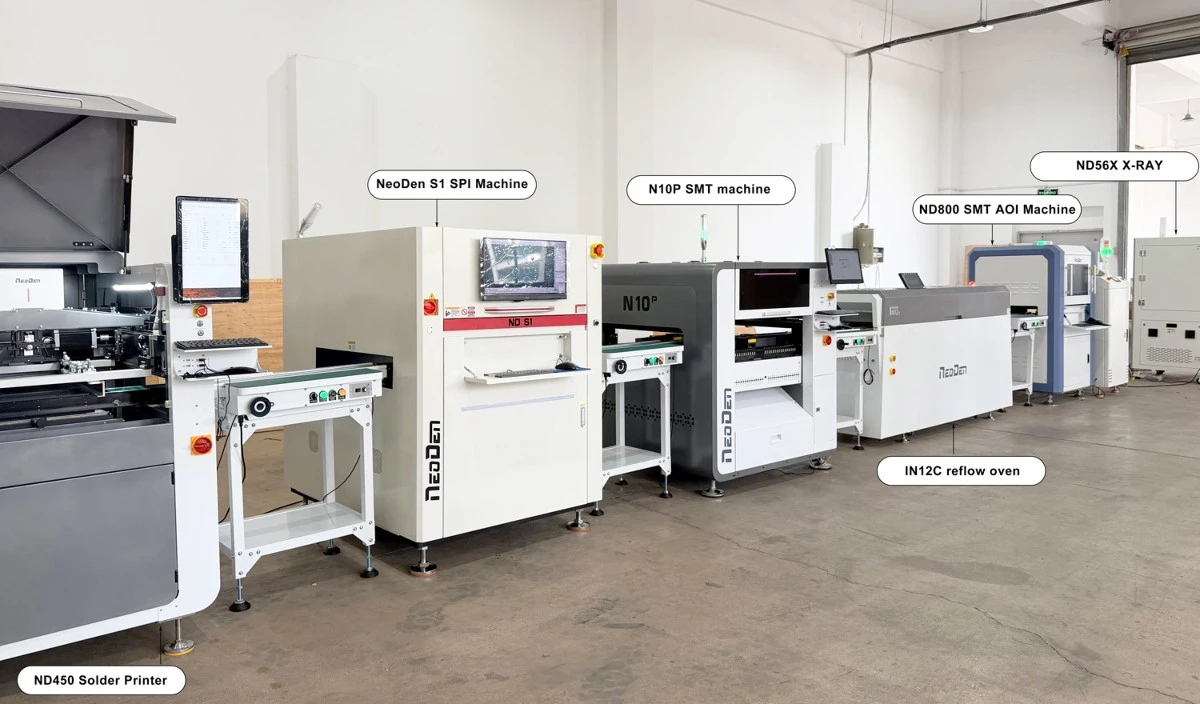
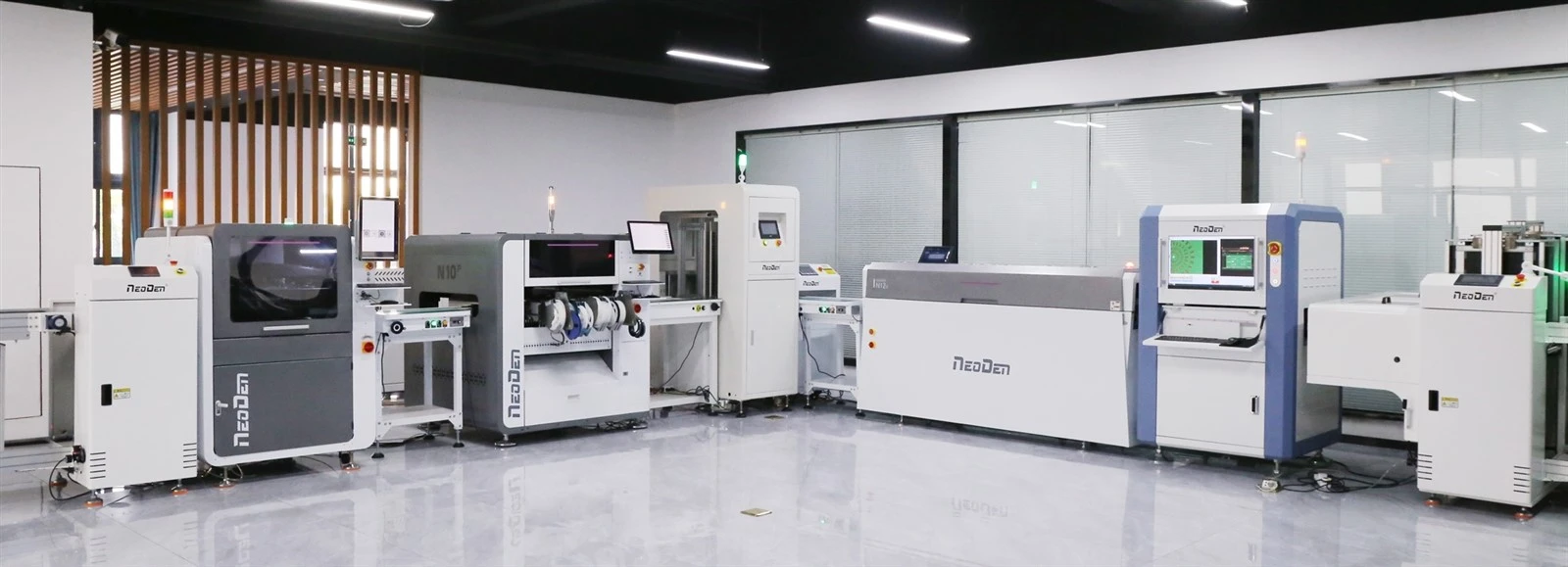
An Industrial SMT Production Line is an automated production system composed of various SMT devices, used to perform PCB surface-mount assembly and related inspection processes.
Compared to desktop SMT equipment used for R&D prototyping or small-batch trials, industrial-grade production lines place greater emphasis on equipment coordination, continuous production capacity, process stability, quality control, and scalability.
1. Basic Production Process of an Industrial-Grade SMT Production Line
A typical SMT production line generally operates according to the following process:
- PCB Loading: The PCB loader feeds bare PCBs into the production line.
- Solder Paste Printing: The solder paste printer applies solder paste to the PCB pads.
- SPI Inspection: SPI inspection equipment checks the quality of the solder paste printing.
- Component Placement: The pick and place machine places electronic components at designated locations on the PCB.
- Reflow Soldering: The reflow oven completes the soldering of components.
- AOI Inspection: AOI equipment inspects for visible component assembly and soldering defects.
- PCB Unloading: The PCB unloader removes the finished PCBs from the production line.
For factories with special inspection and repair needs, X-ray inspection equipment and BGA rework stations can also be added.
2. Core Equipment of an Industrial-Grade SMT Production Line
| Equipment | Main Function | Key Selection Considerations |
| PCB Loader / Unloader | Automatic PCB loading and unloading | PCB dimensions, conveyance method |
| Solder Paste Printer | Solder paste printing | Printing range, alignment method, process requirements |
| SPI | Solder Paste Inspection | Inspection Capability, Inspection Efficiency |
| Pick and Place Machine | Component Placement | Placement Speed, Component Range, Feeder Configuration |
| Reflow Oven | Reflow Soldering | Temperature Zones, Temperature Control, Conveyor Capacity |
| AOI | Post-Soldering Optical Inspection | Inspection Range, Defect Recognition Capability |
| X-Ray | Internal Structure Inspection | Inspection Targets, Product Structure |
| BGA Rework Station | BGA Component Rework | Component Range, Rework Process |
Among these, solder paste printers, pick and place machines, and reflow ovens are the core process equipment in SMT production. SPI, AOI, X-ray, and BGA rework equipment should be selected based on product complexity and quality control requirements.
How to Select SMT Production Line Equipment Based on Production Needs?
After determining which equipment is needed, the next step is to select the appropriate models and configurations based on product characteristics. Equipment selection criteria vary by process step; suitability for production cannot be determined solely by a machine's rated speed.
1. How to Select a Solder Paste Printer?
The quality of solder paste printing directly affects subsequent placement and soldering results. When selecting equipment, key considerations include:
- Whether the PCB size and thickness fall within the equipment's operating range.
- Whether the stencil size and positioning method meet product requirements.
- Whether the printing accuracy and repeatability meet process standards.
- Whether the machine features alignment and squeegee control functions suitable for production needs.
- Whether the machine is easy to operate, clean, and change over.
For example, the NeoDen ND450 can serve as a reference for selecting equipment for the solder paste printing process. When purchasing, confirm the machine's suitability by considering actual PCB specifications, printing requirements, and target production cycle times.
2. How to Select an Industrial-Grade SMT Machine?
SMT placement machines are critical equipment that directly impact the production capacity of an SMT production line. When selecting a model, it is recommended to focus on the following metrics:
- Placement Speed: Understand the machine's rated CPH and evaluate its actual production efficiency under real placement programs.
- Component Compatibility: Confirm whether the machine can handle the resistors, capacitors, ICs, BGAs, and other components required for the product.
- Vision recognition capabilities: Evaluate vision recognition and positioning functions based on component packaging and placement accuracy requirements.
- Feeder system: Consider the number of feeders, feeding methods, and changeover efficiency.
- Production flexibility: If there are many product varieties, also consider program management, material changeovers, and adaptability across different PCBs.
The NeoDen N10P can serve as a reference for selecting industrial-grade placement equipment. For configurations using two placement machines, work must be reasonably allocated based on component distribution, placement tasks, and actual production cycle times.
3. How to Select a Reflow Oven?
The selection of a reflow oven requires consideration of PCB size, board material, component thermal capacity, solder paste type, and production process.
Key considerations:
- Heating zones and temperature control capabilities.
- Hot air circulation and temperature uniformity within the oven.
- PCB conveyor width and transport speed.
- Whether it can meet the reflow profile requirements of the target product.
- Ease of equipment maintenance and daily operation.
The NeoDen IN12C can serve as a reference for selecting reflow soldering equipment. When purchasing, it is recommended to conduct temperature profile tests using actual PCBs and solder paste to confirm that the equipment meets the product's soldering requirements.
4. Is it necessary to configure SPI, AOI, and X-ray systems?
These three inspection systems address different production quality issues.
- SPI: Positioned after solder paste printing, it primarily inspects the quality of the solder paste print and helps detect printing anomalies early.
- AOI: Typically positioned after reflow soldering, it primarily inspects visible component placement and soldering defects.
- X-Ray: Used to inspect internal structures that cannot be directly observed optically, such as specific BGA solder joints.
SPI and AOI can form a complementary process quality control solution, while X-Ray is configured based on product structure and internal solder joint inspection requirements.
If the factory needs to repair BGA components, consider adding BGA rework equipment, such as the NeoDen ND722R BGA Rework Station.
It is important to note that more inspection equipment does not necessarily mean better results. A reasonable combination should be determined based on product type, quality standards, defect risks, and inspection costs.
How to Plan SMT Production Line Capacity and Equipment Quantity?
After determining the equipment models, it is also necessary to plan the overall production line capacity based on order demand. Reasonable capacity planning can prevent equipment capacity shortages and reduce unnecessary equipment investment.
1. Determine Target Production Capacity Based on Product Requirements
Before planning a production line, it is recommended to clarify the following information:
- How many PCBs need to be produced daily.
- How many components each PCB contains.
- How many hours of operation are planned per day.
- Product types and changeover frequency.
- Target yield and equipment utilization rates.
For example, if a factory plans to produce 1,000 PCBs per day with 8 hours of effective production time per day, it must produce an average of 125 qualified PCBs per hour. This is merely the target output for the entire line and does not mean that the placement machine only needs to achieve a placement capacity of 125 pieces per hour. Calculations must also take into account the number of components per PCB, placement time, equipment downtime, and the processing capacity of other production steps.
2. Why Is Actual Placement Speed More Important Than Nominal CPH?
The nominal CPH of a placement machine is typically a theoretical speed obtained under specific test conditions, whereas actual production is also influenced by the following factors:
- Component size and package type.
- Vision recognition and calibration time.
- Feeder layout.
- PCB component distribution.
- Degree of placement program optimization.
- Production changeover and equipment downtime.
Therefore, a machine's nominal CPH cannot simply be equated with the actual production capacity of the entire line.
If two or more placement machines are used, tasks must be allocated based on component distribution and program scheduling, and the line's actual output must be verified through production testing.
3. How can equipment bottlenecks be avoided on a production line?
An SMT production line consists of multiple processes, and the processing speeds of each piece of equipment are not necessarily the same. For example, even if the placement machine can complete placement quickly, the output of the entire line will still be limited if the reflow oven's throughput is insufficient or if the printing and inspection processes cannot keep pace.
Therefore, a comprehensive assessment should be conducted during planning:
- The processing cycle time for solder paste printing.
- The actual placement time of the placement machine.
- The throughput capacity of the reflow oven.
- The inspection efficiency of SPI and AOI.
- The PCB conveying and buffering capacity.
Properly configuring conveyors and buffers can help mitigate short-term cycle time differences between processes, but this cannot replace a thorough analysis of production bottlenecks.
It is recommended that, prior to formal procurement, you provide suppliers with PCB files, BOMs, and component coordinate files to evaluate the equipment configuration through actual program testing and production trials.
Example of an Industrial-Grade SMT Production Line Configuration: NeoDen Reference Solution
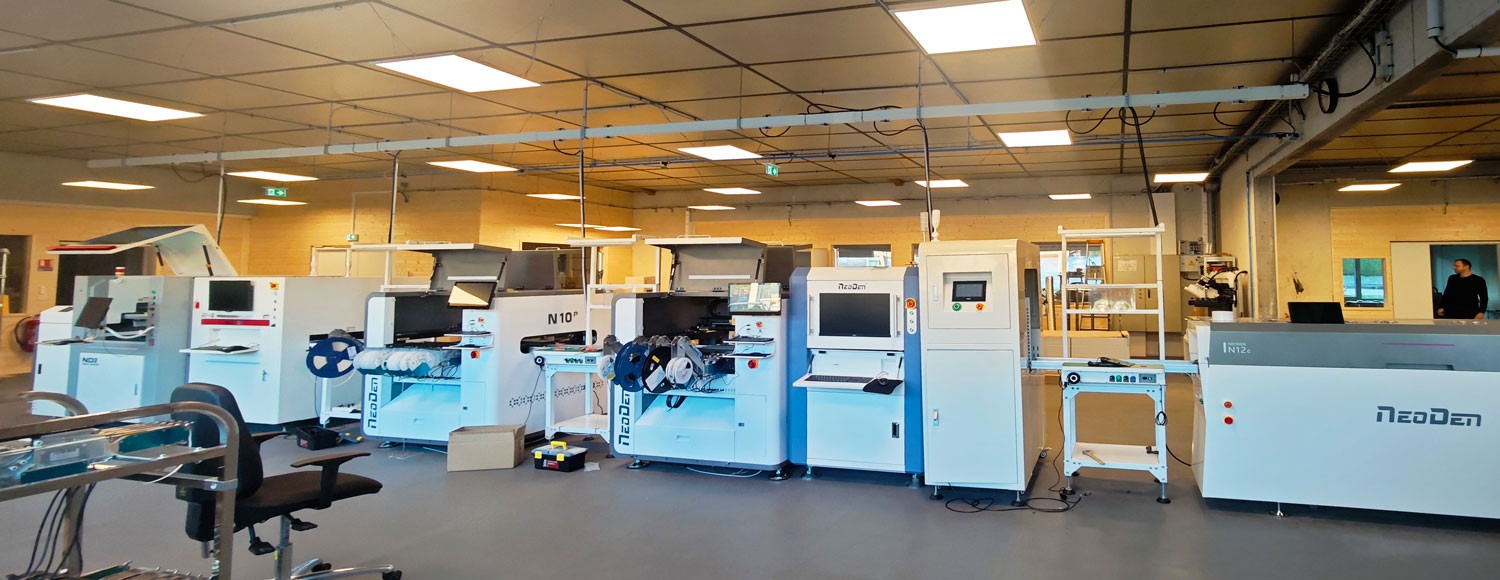
After understanding equipment selection and production capacity planning, you can gain further insight into the configuration of an industrial-grade SMT production line through actual equipment combinations. The following is a reference configuration composed of relevant NeoDen equipment, covering processes such as solder paste printing, inspection, component placement, reflow soldering, and subsequent quality inspection.
1. NeoDen Industrial-Grade SMT Production Line Equipment Configuration
| Production Process | Equipment Configuration | Main Function |
| PCB Loading | PCB Loader | Automatically feeds PCBs into the line |
| Double | NeoDen ND450 | Performs solder paste printing |
| Solder Paste Inspection | NeoDen S1 | SPI Checks solder paste print quality |
| Component Placement | NeoDen N10P × 2 | Performs component placement on the PCB |
| Reflow Soldering | NeoDen IN12C | Performs component soldering |
| Post-Solder Inspection | NeoDen ND800 AOI | Inspects visible assembly and soldering defects |
| PCB Unloading | PCB Unloader | Automatically removes PCBs |
| Internal Solder Joint Inspection | NeoDen ND56X X-Ray | Inspects internal solder joint structure |
| BGA Rework | NeoDen ND722R BGA Rework Station | Meets BGA rework requirements |
2. How does this SMT production line work together?
On the main production line, the PCB first undergoes loading and solder paste printing, then passes through the S1 SPI for solder paste quality inspection. After inspection, it enters the placement process consisting of two N10P machines, followed by reflow soldering performed by the IN12C and post-soldering inspection via the ND800 AOI.
The PCB Unloader is responsible for removing PCBs that have completed processing on the main line from the production line.
The ND56X X-Ray and ND722R BGA Rework Station can be configured as independent workstations based on product inspection and repair requirements and do not necessarily need to be directly connected in series to the main conveyor line.
The actual equipment layout and production capacity of this configuration require further confirmation based on PCB specifications, component distribution, target output, conveyor interfaces, and process requirements.
For different production projects, NeoDen can adjust the equipment configuration based on the customer's specific needs, rather than requiring all factories to adopt an identical setup.
What Factors Should Be Considered When Procuring Industrial-Grade SMT Production Lines?
After determining the equipment configuration and production capacity, the procurement phase requires a comprehensive evaluation of the budget, workshop conditions, and supplier capabilities.
1. How Can You Control the Procurement Costs of SMT Production Lines?
The total investment in an SMT production line is typically influenced by the following factors:
- The models and quantities of core equipment.
- The configuration and production capacity of placement machines.
- The configuration of inspection equipment such as SPI, AOI, and X-ray.
- The number of PCB handling and conveying devices.
- The level of automation and supporting facilities.
- Installation, training, spare parts, and after-sales service.
It is recommended to categorize configurations into basic, recommended, and expandable options based on production needs to avoid over-purchasing, while also ensuring that necessary process capabilities are not overlooked in an effort to reduce the initial budget.
2. How to Plan Production Floor Space?
Equipment layout requires consideration not only of machine dimensions but also of:
- PCB infeed and outfeed directions.
- Operator walkways.
- Space for equipment maintenance and repairs.
- Material replenishment and storage areas.
- Power, compressed air, and other supporting infrastructure.
- Reserved space for future equipment additions.
Providing a floor plan of the production area in advance helps suppliers evaluate equipment arrangements and conveyor solutions.
3. How to Select a Reliable SMT Equipment Supplier?
When purchasing industrial-grade SMT production lines, it is recommended to focus on evaluating:
- R&D and Manufacturing Capabilities: Determine whether the supplier has in-house capabilities for R&D, production, and product testing.
- Product Range: Confirm whether the supplier can provide screen printing, placement, reflow soldering, inspection, and related auxiliary equipment.
- Complete Line Planning Capabilities: Determine whether the supplier can provide equipment configuration recommendations based on PCB specifications, production capacity, and site conditions.
- After-Sales Service: Confirm whether installation and commissioning, operator training, technical support, and spare parts supply are provided.
For factories requiring long-term production, the supplier's technical support capabilities are just as important as the equipment itself.
FAQ
1. What equipment is required for a complete industrial-grade SMT production line?
A typical configuration includes a PCB loader, solder paste printer, SPI, placement machine, reflow oven, AOI, and PCB unloader. X-ray and BGA rework equipment are optional, depending on product structure and quality requirements.
2. How many placement machines are needed for an industrial-grade SMT production line?
The number of placement machines depends on the target output, the number of components on the PCB, component distribution, actual placement speed, and changeover frequency. For some projects, a single machine may suffice, while others may require two or more machines working in tandem.
3. Does an SMT production line always need to be equipped with SPI and AOI?
Not necessarily. SPI primarily inspects solder paste printing quality, while AOI primarily inspects visible component assembly and soldering defects. Whether to include them should be determined based on product complexity, quality standards, and defect control requirements.
4. How is the actual production capacity of an SMT production line calculated?
This requires an evaluation that takes into account the number of components on the PCB, the placement program, equipment cycle time, production time, changeover frequency, and equipment utilization. The production capacity of the entire line cannot be calculated based solely on the nominal CPH of the placement machine.
5. Can industrial-grade SMT production lines be customized according to factory requirements?
Yes. Equipment models, quantities, inspection stations, conveyor methods, and overall layout can all be planned based on PCB size, product type, target output, budget, and workshop space.
Conclusion
When selecting an industrial-grade SMT production line, the key is to ensure that equipment configuration, production capacity, and investment budget are well-aligned.
First, determine the required equipment based on PCB specifications and product processes; second, evaluate placement capacity and the cycle time for each process step based on target output; finally, determine the overall production line solution by considering inspection requirements, workshop space, budget, and supplier service capabilities.
For companies planning to build new production lines or upgrade existing equipment, conducting equipment selection and capacity planning in advance can reduce future retrofitting costs and ensure that the production line better meets actual manufacturing needs.
Build Your Industrial SMT Production Line with NeoDen
Planning a new SMT production line or upgrading your existing manufacturing setup?
NeoDen provides SMT equipment covering solder paste printing, component placement, reflow soldering, inspection and PCB handling.
Share your PCB specifications, component mix, target output and workshop layout with our team. We can help evaluate a suitable SMT line configuration for your production requirements.