



Introduction
In the manufacturing process of high-precision electronic devices, the battle for quality control has long shifted from the macro-level prevention of cold solder joints to the micro-level battle against stress. For circuit board assemblies in the fields of industrial control, automotive electronics, and medical devices, multilayer ceramic capacitors-commonly referred to in the industry as MLCCs-are components that are extremely susceptible to stress damage during processing. Due to the high brittleness of their ceramic substrate, the instantaneous mechanical shear stress applied to the substrate by rotary milling cutters or cutting blades during the final stage of PCBA processing-the mechanical panel separation process-can easily tear fine lattice microcracks inside the capacitor at the base of the pads. To eliminate this hidden hazard on the production floor, the introduction of panel stress sensors and the establishment of real-time dynamic monitoring systems have become mandatory standards for high-end manufacturing enterprises to ensure physical reliability.
Failure Mechanism of Multilayer Ceramic Capacitors Under Mechanical Depaneling Stress
Multilayer ceramic capacitors consist of alternating layers of metal electrodes and ceramic dielectric. While this multilayer physical structure enhances the capacitance density, it exhibits extreme mechanical anisotropy. Ceramic materials have extremely high compressive strength but are extremely fragile under tensile and bending stresses. During mechanical panel separation-whether using a rotary milling cutter or a V-groove separation process-the cutting vibrations and localized warping of the separation equipment can cause slight deformation of the PCB panel. When this deformation is transmitted to the soldered leads of an MLCC, the solder alloy converts the shear force into tensile stress between the ceramic body of the capacitor and the soldered end face of the external electrodes. If the instantaneous tensile stress exceeds the material's physical tolerance limit, micro-shear cracks extending at a 45-degree angle will form inside the capacitor. Such cracks often remain electrically conductive during electrical performance testing at room temperature; however, in subsequent service environments involving humidity and vibration, moisture ingress can cause a precipitous drop in insulation resistance, ultimately leading to a short circuit and the destruction of the entire device.
IPC 9704 Test Specification and Safe Strain Tolerances
To define a safe manufacturing window, the industry typically follows the IPC 9704 test specification established by the Institute for Electronics and Electrical Engineers (IEEE), which provides a quantitative audit of stress conditions during the manufacturing process. For large-sized multilayer ceramic capacitors, such as 0805 or 1206, their inherent long stress arms result in a tolerance for board deformation that is far lower than that of micro-packages. In PCBA manufacturing practice, process engineers typically set the safety threshold at 500 microstrain. When dealing with medical, aerospace, and complex high-power automotive boards, this safety threshold is strictly reduced to within 300 microstrain. Traditional quality management relies on post-production cross-section sampling to assess stress, which not only destroys the samples but also prevents real-time intervention on the running production line. Establishing a stress sensor dashboard system capable of continuous data collection and dynamic early warning is the only way to transition from passive inspection to active control.
Technical Architecture of the Real-Time Stress Sensor Dashboard for Panel Assembly
The construction of a dynamic stress dashboard relies on high-frequency data acquisition and networking technologies that precisely convert physical deformation into digital waveforms. During equipment debugging and production transition verification, technicians apply high-sensitivity three-axis or single-axis impedance strain gauges directly to the PCBA surface-mount board-either at the pads closest to the panel-cutting line or adjacent to MLCC capacitors in high-stress-risk areas. These stress sensors are connected to a high-channel, high-speed dynamic signal acquisition system, with a sampling frequency set to 10 kHz or higher, enabling precise capture of millisecond-level instantaneous mechanical vibrations during panel separation. After analog-to-digital conversion, the acquired electrical signals are transmitted in real time via an industrial bus to the dynamic quality dashboard in the SMT workshop. As the milling cutter head of the panel-separation equipment traverses the corresponding path, the dashboard dynamically plots a curve of instantaneous stress variations, transforming invisible mechanical vibrations and compressive deformation into visual physical waveforms.
Integration with the Digital MES System and Preventive Process Correction
Real-time data presentation can only form a true closed-loop quality defense mechanism when deeply integrated with the Manufacturing Execution System (MES) and the equipment execution end. On the digital production lines of electronics factories, the controllers of the panel-splitting equipment and the dashboard system enable bidirectional data communication. As soon as the panel-splitting stress sensors detect an instantaneous peak of 520 microstrain-exceeding the preset alarm threshold of 500 microstrain-the system sends a shutdown interlock command to the panel-splitting machine via Ethernet within 3 milliseconds. At this point, the panel-splitting track automatically locks, preventing defective boards from reaching the packaging station. Technicians immediately conduct a root cause analysis: inspecting the cutting wear on the panel-splitting machine's milling blades, verifying whether the clamping pressure of the pneumatic fixtures is out of balance, or calibrating positional deviations in the robotic gripper's suction cups. This data-driven preventive control mechanism has completely eliminated the past predicament of producing batches of circuit boards with micro-cracks due to equipment malfunctions, intercepting potential mechanical failures within the factory premises.
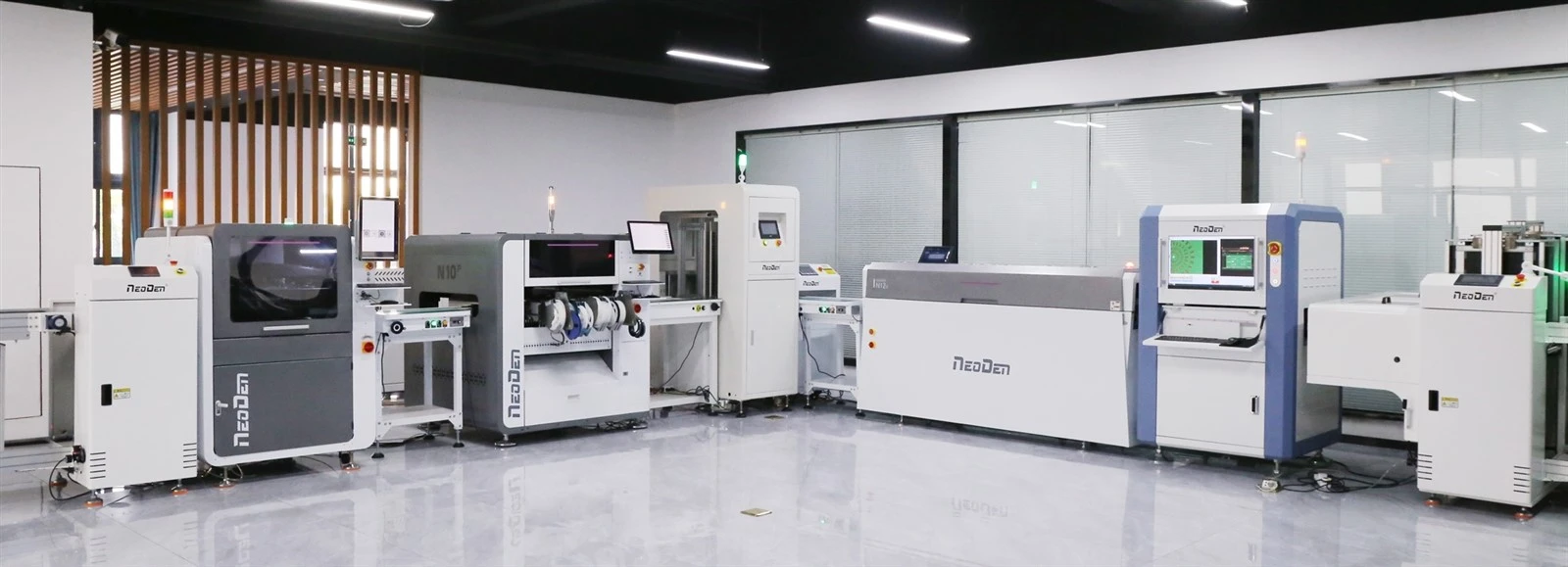
Company profile
- Established in 2010 with 200+ employees & 27,000+ Sq.m. factory of independent property rights, to ensure the standard management and achieve the most economic effects as well as saving the cost.
- Owned the own machining center, skilled assembler, tester and QC engineers, to ensure the strong abilities for NeoDen machines manufacturing, quality and delivery.
- 40+ global partners covered in Asia, Europe, America, Oceania and Africa, to successfully serve 10000+ users in all of the world, to ensure the better and faster local service and prompt response.
- 3 different R&D teams with total 25+ professional R&D engineers, to ensure the better and more advanced developments and new innovation.
- Skilled and professional english support&service engineers, to ensure the prompt response within 8 hours, solution provides within 24 hours.
- The unique one among all of the Chinese manufacturers who registered and approved CE by TUV NORD.
- NeoDen supplies life-long technical support and service for all of the NeoDen machines, moreover, regular software updates based on the using experiences and actual daily request from the endusers.